
BLOG
Green Infrastructure: Noise Barriers and Retaining Walls
Look along any motorway, railway or cycle path and you will see long stretches of concrete: noise barriers, retaining walls, bridge abutments. They do an important job and nobody notices them, until they are covered in graffiti or need to be replaced. These surfaces are also some of the largest in a city, which makes them an opportunity as well as a maintenance problem.
Concrete that works, and that can also live
Concrete panels are a widely recognised answer to noise. High-density concrete blocks sound waves, so noise levels drop on the far side of the barrier. That is why they stand along highways, near railways and around industrial sites. Moss concrete keeps those qualities and adds a living layer: the moss absorbs pollutants and carbon dioxide, softens the look of the landscape and gives insects and small birds a place to live.
The panels are also durable. The concrete resists weathering, vandalism and fire, needs little upkeep, and can be precast in different textures, so a barrier can blend into its surroundings or stand out on purpose.
Hoofddorp: renovating a noise barrier
In Hoofddorp an existing noise barrier had to be replaced or refurbished, and sound reduction was a requirement of the job. Respyre applied Mosscrete to 300 m² of the structure. The moss grows on rainfall and humidity alone, so there is no irrigation system to build or maintain. Moss also has a soft, porous structure that holds moisture and air, which can reduce sound reflections and help the barrier perform better acoustically.
Utrecht: a retaining wall against graffiti
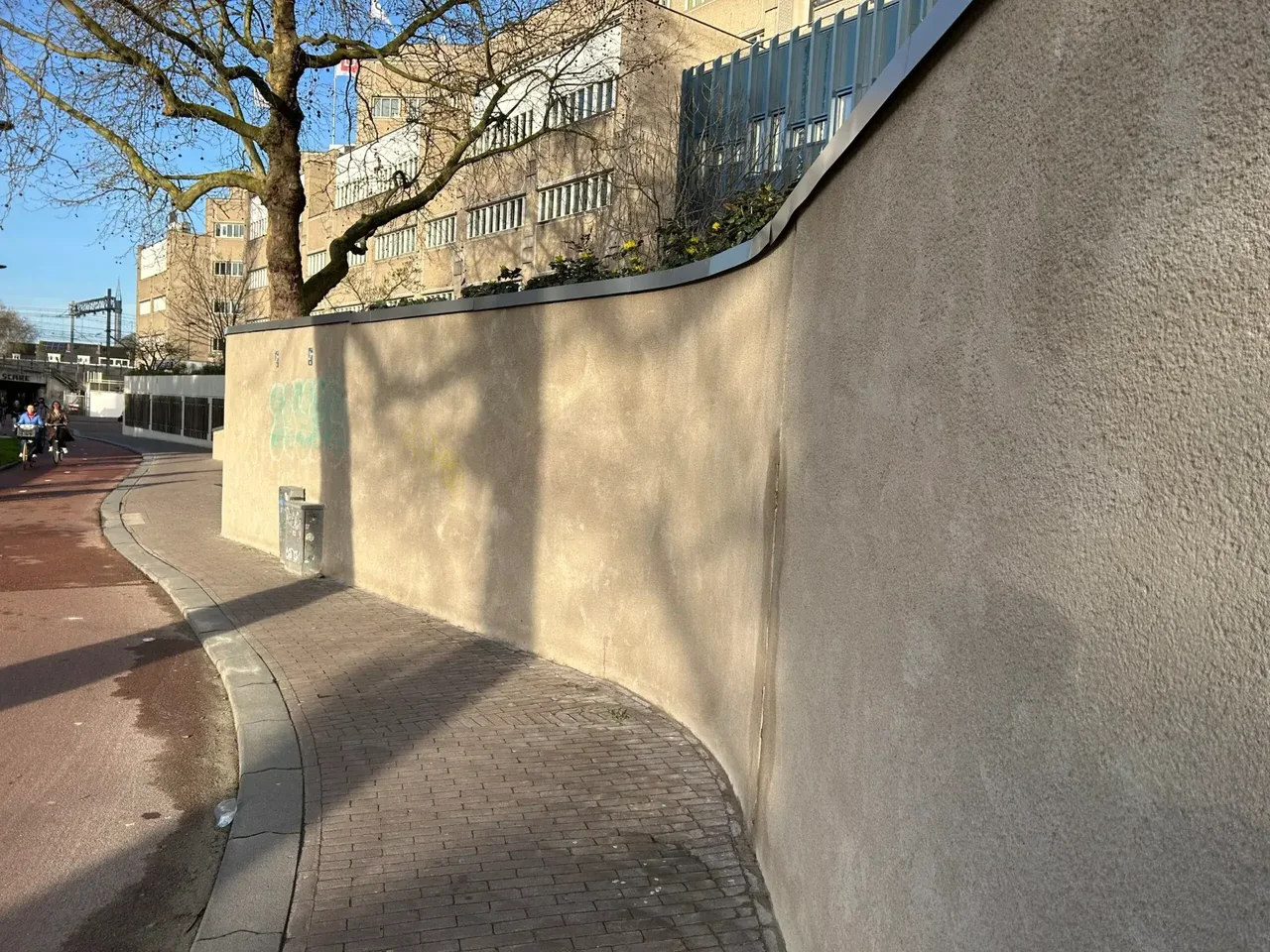
The retaining walls of the Rabobank building in Utrecht were repeatedly sprayed with graffiti, so cleaning them was a constant task. The Utrecht Entrepreneurs Fund chose a different approach: instead of repeated cleaning or temporary coatings, the 135 m² of wall was renovated with bioreceptive concrete. As vegetation develops, the bare surface becomes a green one, graffiti is less likely to return, and the wall offers habitat for plants, insects and other small organisms.
What the two projects have in common
Both were renovations, not new builds: the structure was already there and the green layer was added to it. Both avoided active irrigation and the complexity that comes with it. And in both, the infrastructure kept its technical job while gaining something extra, whether that was acoustics, a cleaner look or more biodiversity.
Questions to ask for your own project
What does the structure have to do? A noise barrier must keep meeting its sound requirements, so check that with your engineer. Is it new or existing? Renovation is a real option, not just new construction. What is the actual problem? Graffiti, an ageing surface and a lack of greenery can all be addressed with the same material. Who will look after it? Passive greening keeps maintenance low, which suits structures that are hard to reach.
Conclusion
Infrastructure will keep being built and renovated, so the question is not whether to have these walls but what they do besides their main task. Hoofddorp and Utrecht show that a barrier or retaining wall can hold its technical performance and still become a green surface. Have a wall or barrier that needs attention? Describe it and we will look at what fits.